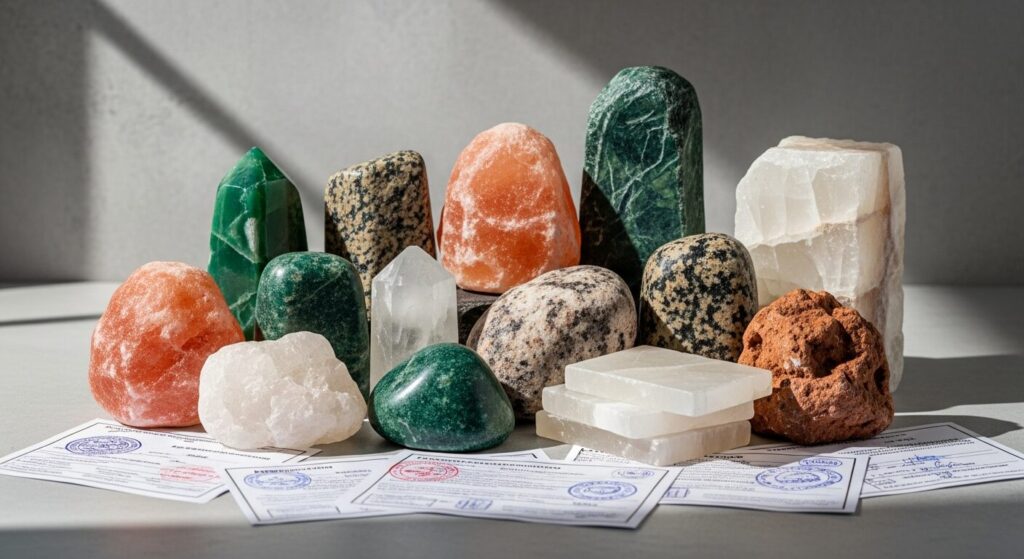
Pakistan Stone Export Documentation: Step by Step Guide for International Buyers
Why Documentation Is the Foundation of Pakistani Stone Trade
Pakistan is one of the world’s most significant sources of natural stone and gemstones, supplying marble from Balochistan, granite from Khyber Pakhtunkhwa, onyx from Punjab, and precious gems including emeralds, rubies, and tourmalines from the northern regions of Gilgit-Baltistan. For international B2B buyers in China, the UAE, Italy, Germany, and the USA, understanding the export documentation process is not a bureaucratic formality — it is a commercial necessity that protects your investment, ensures customs clearance, and builds long-term supplier relationships.
Whether you are sourcing Ziarat white marble for a luxury construction project in Dubai or Patagonia granite slabs for European kitchen countertops, incomplete or inaccurate documentation can cause costly port delays, import rejections, or legal complications. This guide walks you through every document you need, in the correct sequence, so your Pakistani stone shipment arrives smoothly.
Step 1: Confirm Your Supplier’s Legal Export Status
Before any paperwork begins, verify that your Pakistani stone exporter is registered and legally authorized to export. Request the following from your supplier at the inquiry stage.
Required Supplier Credentials
Your Pakistani stone exporter must hold a valid National Tax Number (NTN) issued by the Federal Board of Revenue (FBR), along with a Sales Tax Registration Number (STRN). They should also be registered with the Trade Development Authority of Pakistan (TDAP), which is the primary government body overseeing export facilitation.
Exporters dealing in gemstones — particularly those sourced from Gilgit-Baltistan or Azad Kashmir — may additionally require authorization from the Gems and Jewellery Development Company (GJDC). Always request photocopies of these registrations before signing any purchase agreement.
Step 2: The Commercial Invoice and Proforma Invoice
The commercial invoice is the cornerstone document for every stone export transaction. It must include the exporter’s full legal name and address, the buyer’s details, a detailed description of the stone variety (such as Badal Grey marble, Onyx Green from Charsadda, or Black Granite from Mohmand), HS code classification, unit price, total quantity in metric tons or square meters, and agreed Incoterms such as FOB Karachi or CIF Jebel Ali.
Pricing Accuracy Matters for Customs Valuation
Pakistani marble slabs typically export at FOB prices ranging from USD 18 to USD 65 per square meter depending on thickness, finish, and origin. Onyx blocks from Balochistan can range from USD 200 to USD 800 per metric ton. Gemstones are priced per carat and must be accompanied by grading certificates. Understating prices to reduce import duties in the destination country is illegal and can result in seizure of goods and blacklisting of your supplier relationship.
Step 3: Packing List and Weight Certificate
The packing list provides shipment-level detail that the commercial invoice does not. Each crate or bundle of stone slabs must be itemized with net weight, gross weight, dimensions, and the number of pieces. For buyers in Germany and Italy — where quality control standards in the natural stone sector are particularly rigorous — a precise packing list helps reconcile quantities upon arrival and simplifies warehouse intake processes.
A weight certificate issued by a Pakistan Standards and Quality Control Authority (PSQCA) certified weighing station or the port authority at Karachi Port or Port Qasim adds a layer of independent verification that many European importers require.
Step 4: Certificate of Origin
The Certificate of Origin (COO) confirms that the stone was quarried and processed in Pakistan. This document is issued by the Chamber of Commerce and Industry in the relevant city — for example, the Karachi Chamber of Commerce, the Lahore Chamber, or the Rawalpindi Chamber of Commerce.
Preferential COO for Trade Agreement Buyers
Buyers in China can benefit from the Pakistan-China Free Trade Agreement (PKFTA), which reduces or eliminates tariffs on many categories of natural stone. To claim this benefit, you must request a Form P preferential Certificate of Origin from TDAP. UAE buyers operating under the recently signed Pakistan-UAE bilateral trade framework should similarly verify whether their stone category qualifies for preferential treatment, requiring a TDAP-issued COO rather than a standard chamber document.
Step 5: Quarry License and Mineral Extraction Documents
Increasingly, buyers in the USA and European Union require proof that stone was legally quarried with proper environmental and mining licenses. Request a copy of the quarry lease agreement issued by the relevant provincial Mines and Minerals Department — either the Balochistan Mineral Department, the Punjab Mines Department, or the KPK Directorate of Mines.
This documentation is becoming a standard due diligence requirement under responsible sourcing policies and, in some jurisdictions, may be necessary for customs broker declarations related to environmental compliance.
Step 6: Phytosanitary and Quality Inspection Certificates
For certain importing countries, a quality inspection certificate is required before or during loading. PSQCA offers pre-shipment inspection services for stone products. SGS Pakistan, Bureau Veritas, and Intertek all operate inspection offices in Karachi and Lahore and can issue internationally recognized quality reports covering slab thickness tolerance, surface finish, water absorption rates, and compressive strength — all specifications critical to buyers sourcing for construction or fabrication use.
Step 7: Bill of Lading and Shipping Documents
Once the cargo is loaded at Karachi Port or Port Qasim, the shipping line issues the Bill of Lading (B/L), which serves as the title document to the goods. This must match every detail on the commercial invoice and packing list exactly. Any discrepancy — even in spelling — can trigger a customs hold at destination ports in Shanghai, Dubai, Hamburg, or Los Angeles.
Letter of Credit Coordination
Many first-time transactions between Pakistani exporters and international buyers are conducted under a Letter of Credit (LC) issued by the buyer’s bank. Ensure your LC specifies all required documents by name and that your Pakistani supplier confirms they can comply with each documentary condition before the LC is issued. This prevents costly LC amendments and shipment delays.
Step 8: Gemstone-Specific Documentation
If your shipment includes rough or polished gemstones from Pakistan’s northern regions, additional documentation is required. Precious and semi-precious stones must be accompanied by a gemological certificate from a recognized laboratory such as GIA, GRS, or the Gemmological Institute of Pakistan. Export of certain minerals may also require a No Objection Certificate (NOC) from the Geological Survey of Pakistan.
Building a Long-Term Supply Chain with Pakistani Stone Exporters
Mastering the documentation process is the first step toward building a reliable, scalable supply chain from Pakistan’s world-class stone and gemstone sector. Buyers who understand these requirements are better positioned to negotiate payment terms, reduce clearance times, and develop exclusive sourcing partnerships with quarry owners and processors across Balochistan, Punjab, Sindh, and Gilgit-Baltistan.
Pakistani stone exporters who maintain organized, compliant documentation portfolios are the suppliers worth prioritizing. They demonstrate professionalism, reduce your legal exposure, and signal a business culture aligned with international trade standards.
Find Pakistani Stone Exporters on PakiStone.com
Ready to source marble, granite, onyx, or gemstones from Pakistan with confidence? Browse our directory of Pakistani stone and gemstone exporters at PakiStone.com. Connect directly with suppliers who understand international documentation requirements, export to China, UAE, Italy, Germany, and the USA, and are ready to provide sample shipments, COO documentation, and competitive FOB pricing. Start your sourcing journey today at PakiStone.com and turn Pakistan’s extraordinary natural stone wealth into your competitive advantage.