Pakistani Stone vs Competitors: Buyer Comparison Guide
International buyers sourcing natural stone have multiple country options including Italy, Turkey, Iran, India, China, and Egypt. Understanding how Pakistani stone compares to these established suppliers helps buyers make informed sourcing decisions. This guide provides an data-driven comparison across quality, price, variety, and reliability dimensions.
Pakistani Marble vs Italian Marble
Italian marble — particularly Carrara, Calacatta, and Statuario — commands the highest global prestige and prices. Pakistani white marble from Ziarat is the most direct competitor to mid-grade Carrara, offering comparable whiteness and crystalline texture at 30-50% lower cost. For buyers where budget is a constraint but white marble aesthetics are required, Pakistani Ziarat marble delivers outstanding value. Italian marble retains advantage in brand recognition and architectural specification for premium projects where origin matters to end clients.
Pakistani Onyx vs Iranian Onyx
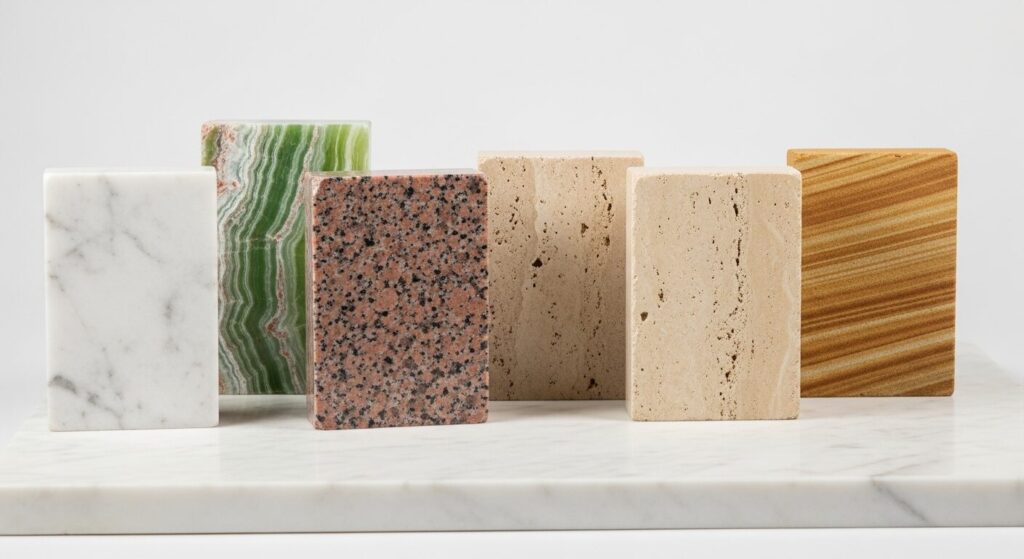
Pakistan and Iran are the world’s two dominant onyx producers. Pakistani green onyx generally offers superior translucency and cooler green tones compared to Iranian material which tends toward yellower, warmer greens. Iranian onyx has historically had stronger distribution networks in Europe and the Middle East. However, international sanctions on Iran have disrupted supply chains, pushing more buyers toward Pakistani sources. For backlit applications specifically, Pakistani multi-green onyx is preferred by leading interior designers globally.
Pakistani Gemstones vs Colombian and Zambian Alternatives
Swat emeralds compete directly with Colombian and Zambian material. Colombian emeralds command the highest premiums due to established brand recognition and consistent supply through major trading houses. Swat emeralds match Colombian material in color quality at top grades but trade at a 20-40% discount due to lower market recognition — representing exceptional value for informed buyers. Zambian emeralds offer higher supply volumes and more consistent commercial grade material. Pakistani aquamarine from Gilgit-Baltistan has no quality peer — Skardu material is recognized as among the finest aquamarine in the world.
Pakistani Stone vs Turkish Stone
Turkey is the world’s largest marble exporter by volume, with highly developed processing and export infrastructure. Turkish marble offers consistent quality, reliable supply, and competitive pricing backed by sophisticated logistics. Pakistani marble competes effectively on price for comparable white marble varieties and offers unique colors and stones (particularly onyx) not available from Turkish sources. Buyers seeking pure price competitiveness on white marble find Turkish and Pakistani material in close competition, with Pakistani winning on exotic variety.
Pakistani Stone vs Indian Stone
India is a major competitor to Pakistan in several stone categories. Indian Makrana marble competes directly with Ziarat white marble. Indian granite has a well-established global export infrastructure advantage over Pakistani granite. Pakistani onyx has no Indian equivalent — India does not produce significant commercial onyx volumes. Trade restrictions between Pakistan and India mean Pakistani and Indian buyers cannot source from each other directly, pushing both toward third-country alternatives.
Price Comparison Summary
On pure price competitiveness, Pakistani stone consistently undercuts Italian and Turkish alternatives by 25-50% for equivalent quality grades. Against Indian stone, Pakistani pricing is comparable with advantages varying by product category. Against Chinese stone, Pakistani decorative varieties (onyx, Himalayan salt) have no Chinese equivalent, while Chinese granite and standard marble compete aggressively on price for commodity grades.
Why Buyers Choose Pakistan
The most compelling reasons to source stone from Pakistan are unique products unavailable elsewhere (Multi-Green Onyx, Himalayan Pink Salt, Swat Emeralds, Skardu Aquamarine), price competitiveness against European alternatives, and significant untapped supply capacity. The main challenges are less developed export infrastructure compared to Italy or Turkey, and lower global brand recognition requiring more buyer-side due diligence. PakiStone.com exists specifically to bridge this gap — connecting international buyers with Pakistani exporters and providing the information needed to source confidently.